

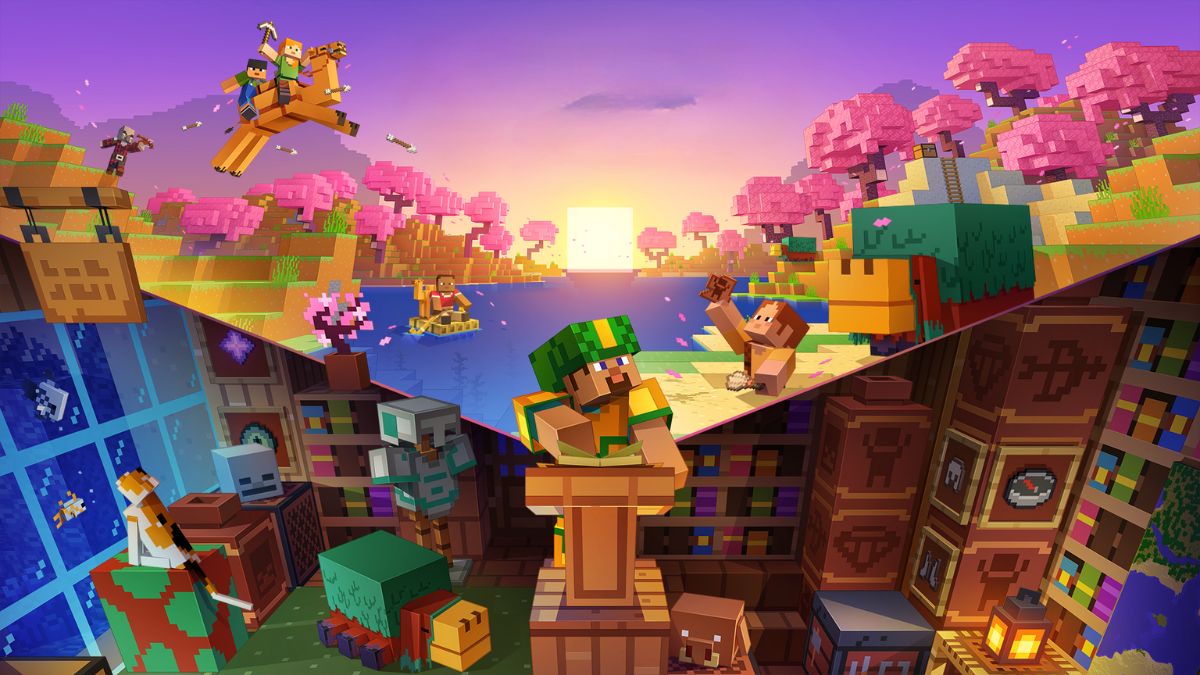
Introduction to Minecraft
Minecraft continues inspiring millions through creativity, exploration, survival gameplay, and limitless freedom inside one of gaming’s most imaginative digital worlds.
There’s something strangely emotional about placing the first block in Minecraft.
No dramatic cinematic.
No loud introduction.
No complex tutorial explaining exactly what to do next.
Just silence, open land, distant mountains, moving clouds, and a world waiting patiently for your imagination to shape it.
For many players across the United States, Minecraft wasn’t simply another game they played for a few weeks before moving on. It became a space they returned to repeatedly throughout different stages of life.
Some remember building wooden shelters before nightfall for the first time.
Others remember exploring caves with friends late at night.
Some remember creating entire cities block by block over months of dedication.
And that’s the fascinating thing about Minecraft.
Everyone experiences it differently.
That flexibility is exactly why it remains one of the most influential games ever created.
Years after release, Minecraft still dominates gaming conversations, educational discussions, streaming culture, and creative communities worldwide — not because it constantly forces excitement, but because it quietly gives players something increasingly rare in modern entertainment:
Freedom to imagine.
Deep Analysis: Why Minecraft Became More Than Just a Game
At first glance, Minecraft looks deceptively simple.
Blocky graphics.
Minimal storytelling.
Basic mechanics.
Yet beneath that simplicity exists one of the deepest player-driven experiences in gaming history.
Minecraft succeeds because it transforms players from consumers into creators.
Most games ask players to complete experiences designed by developers.
Minecraft asks something entirely different:
“What kind of experience do you want to create yourself?”
That single shift changes everything.
Instead of following rigid objectives constantly, players create personal goals:
-
building homes,
-
surviving difficult nights,
-
exploring hidden biomes,
-
constructing giant cities,
-
designing farms,
-
recreating real-world landmarks,
-
or simply wandering without urgency.
This freedom produces emotional ownership.
And emotional ownership creates long-term attachment.
Players don’t merely remember Minecraft worlds.
They remember their Minecraft worlds.
That distinction is incredibly important psychologically.
According to engagement studies in interactive entertainment, player-generated creativity strongly increases emotional investment and long-term retention [Source: Newzoo, 2025].
Minecraft demonstrates this principle better than almost any game ever released.
Minecraft and the Psychology of Creativity
One reason Minecraft resonates across generations is because it encourages creative thinking without pressure.
Many modern games reward efficiency.
Minecraft rewards imagination.
There’s no single correct way to build a house.
No mandatory strategy for exploration.
No universal definition of success.
That openness makes the experience feel deeply personal.
For children, Minecraft often becomes a playground for experimentation.
For adults, it can feel surprisingly therapeutic.
Building slowly, organizing resources, shaping landscapes, and watching ideas materialize block by block creates a calming sense of progression.
In many ways, Minecraft resembles digital architecture mixed with survival storytelling.
Players are constantly solving problems creatively:
-
How should this structure look?
-
Where should resources be gathered?
-
How can this environment become safer?
-
What happens beyond the next mountain?
These small decisions quietly stimulate imagination continuously.
And because the game rarely punishes creativity, players feel encouraged to experiment more freely.
Practical Applications and Useful Minecraft Strategies
Despite its relaxing appearance, Minecraft contains surprisingly deep survival systems.
New players often underestimate how important planning becomes during early gameplay.
The first in-game night teaches an important lesson quickly:
preparation matters.
Experienced players typically prioritize:
-
shelter construction,
-
food collection,
-
resource management,
-
tool progression,
-
and environmental awareness.
But beyond survival mechanics, Minecraft also rewards patience.
Unlike fast-paced competitive games, Minecraft rarely demands constant urgency. Some of the most rewarding moments come from long-term projects completed gradually over time.
A massive castle built over weeks often feels more satisfying than instant rewards found in traditional games.
This slower pacing creates emotional durability.
Players become attached not only to outcomes, but to the process itself.
That’s part of what makes Minecraft emotionally memorable years later.
Storytelling Through Exploration and Discovery
Minecraft’s storytelling style is unique because much of it emerges naturally rather than being explicitly written.
The game world constantly creates small narratives:
-
getting lost far from home,
-
surviving dangerous caves,
-
discovering hidden villages,
-
escaping enemies with minimal health,
-
or accidentally destroying hours of work.
These moments become personal stories players retell repeatedly.
Unlike heavily cinematic games, Minecraft allows emotion to emerge organically.
That creates authenticity.
One player may remember surviving their first thunderstorm inside a tiny dirt shelter.
Another remembers traveling across oceans searching for rare biomes.
Someone else remembers building with siblings during childhood summers.
The game quietly transforms ordinary gameplay into emotional memory.
That emotional personalization explains why Minecraft communities remain so strong globally.
People don’t just discuss mechanics.
They discuss experiences.
Source:
Minecraft also became one of the most influential games in online content creation culture.
Streaming platforms, video creators, and online communities embraced the game because it naturally generates endless variation.
No two worlds feel identical.
No two player journeys unfold exactly the same way.
That unpredictability keeps audiences engaged for years.
Unlike linear games that become repetitive after completion, Minecraft constantly reinvents itself through player imagination.
Expert Insights and Common Mistakes New Players Make
One of the most common beginner mistakes in Minecraft is focusing entirely on aesthetics too early.
New players often spend excessive time building elaborate structures before establishing reliable survival systems.
Experienced players usually prioritize:
-
sustainable food sources,
-
storage organization,
-
defensive preparation,
-
and efficient resource gathering first.
Another mistake involves exploring recklessly.
Minecraft rewards curiosity, but it also quietly punishes poor preparation. Getting lost without coordinates, entering caves without sufficient supplies, or underestimating environmental dangers often leads to frustrating setbacks.
Veteran players understand the importance of pacing.
Minecraft is not designed to be rushed.
Trying to accelerate progression too aggressively often reduces the sense of wonder that makes the experience meaningful in the first place.
The Advanced Perspective: Minecraft as a Digital Creative Platform
Over time, Minecraft evolved far beyond gaming.
It became a creative platform.
Players now use Minecraft for:
-
architecture projects,
-
educational environments,
-
collaborative storytelling,
-
virtual events,
-
coding experiments,
-
and social interaction.
This transformation reflects a much larger shift happening across digital culture.
Games are no longer only entertainment products.
Increasingly, they function as creative ecosystems.
Minecraft became especially influential because its systems encourage participation rather than passive consumption.
Players actively shape the world instead of simply moving through it.
That sense of agency is powerful.
And in an era where many digital experiences feel overly controlled or algorithmically guided, Minecraft’s openness feels refreshing.
Trends, Data, and the Current State of Minecraft
Despite being released years ago, Minecraft continues maintaining enormous global relevance.
Industry reports consistently show strong player engagement, especially among younger audiences and creative gaming communities [Source: Statista, 2025].
The game’s longevity comes largely from adaptability.
Minecraft survives trends because it doesn’t rely entirely on trends.
Its core appeal — creativity, exploration, survival, and personal expression — remains timeless.
Educational institutions have also increasingly explored sandbox games for collaborative learning environments and creative problem-solving exercises [Source: EdSurge, 2024].
Minecraft’s flexible structure supports these applications naturally.
Meanwhile, streaming culture continues introducing new generations of players to the game every year.
Content creators constantly reinvent gameplay through:
-
survival challenges,
-
custom worlds,
-
multiplayer storytelling,
-
speedrunning,
-
roleplay servers,
-
and massive collaborative builds.
This endless reinvention keeps the ecosystem alive.
Comparing Minecraft to Other Sandbox and Survival Games
Many survival games emphasize difficulty.
Others emphasize realism.
Some prioritize combat.
Minecraft balances these elements differently.
Its greatest strength is accessibility.
A child can enjoy simple building mechanics immediately.
An experienced player can spend years mastering advanced systems like:
-
automation,
-
engineering,
-
large-scale construction,
-
or technical survival strategies.
Very few games successfully support both casual creativity and deep complexity simultaneously.
Minecraft also differs from many modern games because it encourages slower emotional pacing.
There’s room for silence.
Room for wandering.
Room for experimentation without constant pressure.
That slower rhythm creates a unique emotional atmosphere rarely replicated elsewhere.
Reference:
Another major distinction involves emotional tone.
Some games create excitement primarily through competition or danger.
Minecraft often creates emotion through discovery.
The first time a player finds a hidden underground cave glowing with rare resources can feel strangely magical. So can watching sunrise appear over a landscape they spent weeks building themselves.
These quieter emotional moments are part of the game’s lasting power.
Common Concerns and Misunderstandings Around Minecraft
Some critics initially dismissed Minecraft because of its visual simplicity.
But that simplicity became one of its greatest strengths.
The minimalist design encourages imagination instead of limiting it through excessive realism.
Another misconception is that Minecraft lacks structure or meaningful progression.
In reality, the game contains layered systems involving survival mechanics, exploration, crafting, resource management, and increasingly advanced player goals.
The freedom simply allows players to approach progression differently.
Some pursue technical mastery.
Others prioritize artistic creativity.
Some focus entirely on exploration or multiplayer experiences.
That flexibility explains why the game appeals across age groups so effectively.
Final Thoughts and What Comes Next
Minecraft remains one of the world’s most influential games because it understands something deeply human:
People don’t just want entertainment.
They want the ability to create.
To explore.
To shape something personal.
To leave marks on worlds that feel meaningful.
Minecraft provides that experience in one of the purest forms modern gaming has ever seen.
Its worlds feel endless not only because of their size, but because of their possibilities.
And perhaps that’s why so many players continue returning year after year.
Not simply to survive.
But to imagine something new again.
References
-
Newzoo. (2025). Creative Sandbox Gaming and Player Retention Report.
-
Statista. (2025). Global Sandbox Game Engagement Statistics.
-
Psychology Today. (2024). Creativity, Exploration, and Emotional Development in Gaming.
-
EdSurge. (2024). Interactive Learning Through Sandbox Game Environments.
-
GamesIndustry.biz. (2025). The Long-Term Influence of Minecraft on Modern Game Design.